
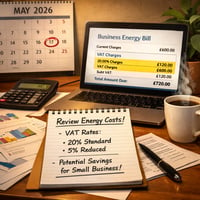
Of all the lines on a UK business energy bill, VAT is the one that gets the least attention — and...
State of the UK energy market
**The State of the UK Business Energy Market: What SMEs Need to Know Now**
The UK business energy market has been through one of its most turbulent periods in recent memory. After the shocks of 2022–23, many companies hoped business energy prices would quickly return to “normal”. Instead, SMEs now face a landscape defined by elevated costs, ongoing price volatility, complex contracts and tightening regulation.
For many small and medium-sized businesses, energy is no longer just a background overhead. Rising SME energy costs are hitting margins, squeezing cash flow and, in some cases, threatening business viability. Understanding what’s really happening with business electricity rates and business gas prices – and how to respond – is now a critical part of running a resilient, profitable company.
In this article, we’ll look at the current state of the UK business energy market, what it means for SMEs, what to watch in 2025/26, and the practical steps you can take now to protect your business.
---
## What’s happening in the UK business energy market now?
### Wholesale prices: down from the peak, but still not “cheap”
Wholesale energy prices have fallen significantly from the extreme highs seen during the energy crisis, but they remain well above historic norms. For businesses, that means:
- Renewals often still feel expensive compared to contracts agreed pre-2021
- There is more choice and competition than during the crisis, but pricing remains sensitive to global events, weather and gas supply concerns
- Fixing business energy for longer terms can be attractive, but timing your energy switching window is more important than ever
The result is a market where you can secure better value than during the worst of the crisis—but only if you’re actively engaged, comparing deals and negotiating.
### Standing charges and non-commodity costs putting pressure on bills
Even where unit rates have eased, standing charges and non-commodity costs (network charges, policy costs and other regulated elements) continue to weigh heavily on bills. For many SMEs, these fixed charges now represent a larger share of their monthly energy spend than they expect.
This matters because:
- Reducing usage alone doesn’t always deliver the savings businesses hope for
- The structure of your tariff and site set-up (for example, your kVA capacity on half-hourly meters) can have a big impact on what you pay
- Reviewing your charges and capacity can unlock savings that aren’t visible from headline unit rates alone
### Contract complexity and “default” rates
The UK business energy market is dominated by fixed-term contracts. While they can protect you from sudden price spikes, they also mean:
- If you miss your energy switching window, you can roll onto expensive out-of-contract or deemed rates
- Some contracts have complex terms, early termination fees or take-or-pay clauses that make decisions harder
- Many businesses are still on contracts agreed at the peak of the market, or have rolled onto high default tariffs without realising
Active contract management is now essential – waiting for your supplier to “do the right thing” is rarely a winning strategy.
---
## How current market conditions impact SMEs
SMEs are feeling the pressure of the UK business energy market more acutely than larger corporates:
- **Tighter margins:** Energy is a bigger percentage of total costs for many small firms, especially in manufacturing, hospitality, retail and logistics.
- **Less buying power:** SMEs often don’t have the scale to secure the very lowest business electricity rates or business gas prices directly from suppliers.
- **Limited in-house expertise:** Few smaller businesses have an energy manager or procurement specialist; energy decisions are typically made by owners or directors alongside many other priorities.
- **Cash flow risk:** High and unpredictable bills make budgeting difficult and can undermine plans for growth or investment.
At the same time, SMEs are under pressure from customers, supply chains and lenders to demonstrate progress on sustainability and net zero, adding another layer of complexity to energy decisions.
---
## What to watch in 2025/26: regulation, brokers, net zero and smart tech
### Increasing regulation and scrutiny of brokers and intermediaries
Ofgem and UK policymakers are paying much closer attention to the way business energy is sold, particularly to microbusinesses and SMEs. There is growing scrutiny of:
- Hidden commissions and opaque pricing by some energy brokers and third-party intermediaries (TPIs)
- Mis-selling, aggressive sales tactics and lack of transparency in contract terms
- The need for clearer information to help businesses make informed decisions
You can expect further regulatory changes aimed at increasing transparency, improving standards and protecting businesses from unfair practices. Working with reputable, transparent energy brokers will become even more important.
### Net zero, ESG and the push for cleaner energy
Pressure is mounting on businesses of all sizes to decarbonise:
- Larger customers and public sector buyers are increasingly asking suppliers for evidence of carbon reduction plans
- Grants, incentives and financing options for efficiency and renewables are evolving
- Future policy changes could further reward efficient, low-carbon businesses—or penalise those that lag behind
Aligning your energy strategy with your net zero ambitions is no longer a “nice to have”; it’s becoming central to long-term competitiveness.
### Growth of smart technology and data-driven energy management
The rollout of smart meters and advanced energy management technology is reshaping how businesses use and buy energy:
- Half-hourly data gives better insight into when and how your business uses power
- Automated controls, smart thermostats and building management systems can reduce waste without burdening staff
- Data from smart metering supports more accurate TCR and kVA reviews, as well as better procurement decisions
SMEs that embrace these tools early can often find savings their competitors miss.
---
## Practical steps SMEs can take now
The good news is that, even in a challenging UK business energy market, there are clear, actionable moves you can make to cut costs and reduce risk.
### 1. Shop around and use your energy switching window
- Don’t wait for your renewal letter. As soon as you enter your **energy switching window**, start comparing business energy prices from multiple suppliers.
- Look at both unit rates and standing charges; a “cheap” unit rate can be offset by a high daily charge.
- Consider your risk appetite:
- **Fixed contracts** for budget certainty
- **Flexible or shorter fixes** if you believe prices may fall further and can tolerate some volatility
A trusted broker can help you navigate the options and negotiate on your behalf.
### 2. Fix business energy strategically
Fixing business energy for 1–3 years can protect you from price spikes, but only if the timing and structure are right:
- Avoid making decisions in a rush at the last minute
- Check whether the contract has fair termination and volume terms
- Consider staggering end dates across multiple sites if you operate more than one location, to reduce exposure to a single market moment
### 3. Conduct an energy audit and tackle quick wins
Energy efficiency is still one of the most reliable ways to tackle SME energy costs:
- Commission an **energy audit** to identify where you are wasting electricity and gas
- Prioritise low-cost, high-impact measures: LED lighting, insulation, heating controls, shutting down non-essential equipment out of hours
- Engage staff in simple behaviours that reduce consumption without affecting service
Efficiency improvements cut costs every month, regardless of what the market does.
### 4. Review TCR and kVA for half-hourly meters
If your business has half-hourly metering:
- Ask for a **Targeted Charging Review (TCR)** and **kVA capacity review**
- Many businesses are on legacy TCR bands or have capacity set higher than they need, meaning they’re overpaying on fixed charges
- Adjusting your capacity and banding in line with your actual usage can deliver significant savings, even if your unit rate stays the same
### 5. Explore on-site renewables and low-carbon options
For sites with suitable space and budget:
- **Solar PV** can reduce your reliance on grid electricity, smooth out bills and support your net zero goals
- In some cases, battery storage or other technologies may also be viable
- Combining renewables with smart controls and an optimised contract can significantly reshape your long-term energy cost profile
A specialist adviser or broker with experience in both procurement and renewables can help you assess the business case.
---
## Take control of your business energy costs
The UK business energy market will likely remain complex and volatile for the foreseeable future. But SMEs are not powerless.
By understanding how business electricity rates and business gas prices are set, actively managing your contracts, investing in efficiency, and using smart technology and reviews like TCR and kVA, you can reduce risk and bring your energy spend back under control.
If you haven’t reviewed your contracts or compared business energy prices recently, now is the time.
Work with a transparent, trusted energy broker to:
- Review your current tariffs and standing charges
- Plan your strategy around your energy switching window
- Explore opportunities to fix business energy on better terms
- Identify savings through audits, capacity reviews and efficiency measures
Taking action today can help protect your margins, support your growth plans and give you a stronger, more resilient position in the UK business energy market.
Give The Utilities Group a call on 0151 5416767 or hello@utilitiesgroup.co.uk